Sunday, December 12, 2010

Michael Baldwin & the Bloodhounds Mob the Governor: Speculation and the "Ohio Revolution"

After a hiatus of nearly a year, I am glad to finally post some “new” material.  This and the following post will cover the remainder of my paper, which was presented at a conference hosted by Prof. Matthew Ward of the University of Dundee in July 2009.  In my original presentation I argued that land speculation in the Scioto River Valley generated lawlessness and disorder during the frontier stage of the region’s development.  Clashes over the location of seats of justice and county boundary lines often illumined partisan divisions in the region, as well as nationally.  ~ ALF


The nearly three-year long struggle over the location of the Adams County seat (1797-1799) helped precipitate what historian Donald J. Ratcliffe has called the “Ohio Revolution of 1800,” wherein a popular surge in Jeffersonian Democracy found its expression in a statehood movement that successfully toppled the regime headed by Federalist Territorial Governor Arthur St. Clair.  When Adams County's largest landowner, Nathaniel Massie, battled Governor St. Clair over the location of the county's seat (as discussed in the previous post), Massie’s primary interests were becoming increasingly tied to the development of the town of Chillicothe, which was located in the northeastern corner of the county.  St. Clair’s greatest fear was the possibility of the creation of a new state government under the control of Jeffersonian Democrats, with its capital located at Chillicothe.  To avert such a development, St. Clair launched a campaign to have Congress divide the North-West Territory, ensuring that Chillicothe would not be located at the center of any future state of Ohio.

Nathaniel Massie, founder of Manchester and Chillicothe, Ohio
 While St. Clair worked his network of Federalist members of Congress and Adams administration officials, the Virginians worked their congressional allies.  Federal intervention, it now appeared to Massie and others, could be used to secure their investments and larger fortunes.  Congress could block St. Clair’s boundary division plans, fix the seat of a new territorial government at Chillicothe, and authorize the formation of the State of Ohio, encompassing the eastern portion of the larger North-West Territory.

If St. Clair was going to use his federal authority to thwart the interests and fortunes of settlers in the Scioto Valley, Massie and others, having previously benefitted from the actions of the Federal government in the acquisition of their land, would also use their influence at the federal level to forward their interests.  The contest would boil over in the streets of Chillicothe.  The contest over county seat locations became tied to the larger issues of whether St. Clair would succeed in establishing the Scioto River as a new territorial boundary, slicing Ohio into two new federal territories, and whether the new territorial seats of government should be located in Cincinnati in the West and Marietta in the East, two cities that included powerful Federalist factions.


Northwest Territorial Governor Arthur S
The fortunes of Chillicothe and the other county seats in the Scioto Valley hung in the balance.  The region had attracted skilled artisans and merchants; farmers, large and small, had begun to clear and fill the hinterlands of VMD towns.  Personal interest in these matters cut across class-lines, from the hardworking black smith and penniless, but ambitious tenant farmer, to the young lawyers and wealthy land speculators – all had a personal interest in the larger fortunes of their region and the location of their seats of government.  Many of the new settlers had gambled on a bright, prosperous future in the valley; they had staked their all in establishing farms and businesses in these frontier towns and the surrounding fertile lands.  Support for statehood was truly a popular phenomenon, shared by the leading politicians of the Scioto valley and the overwhelming majority of their constituents.  It truly was a popular republican revolution.

Although St. Clair had vetoed the Adams county seat bill at the first session of the Territorial Assembly, representatives from the VMD succeeded in having William Henry Harrison (another Virginian) elected as the territory’s first non-voting delegate to Congress.  Massie along with others, who would become known as the Chillicothe Junta, would also send Chillicothe resident, Thomas Worthington to Philadelphia, the temporary seat of the Federal government, to lobby on their behalf.  Worthington had immigrated from Virginia to Chillicothe in 1797, had served as a Justice of the Peace with Massie in Adams County, and had recently been appointed Surveyor-General of the North-West Territory, where he would oversee the sale of federal lands outside the VMD, on the east side of the Scioto River.  Finding allies among Democratic-Republicans, Harrison, with the assistance of Worthington, succeeded in blocking St. Clair’s division along the Scioto and instead secured passage of the Virginians’ plan to divide the larger Northwest Territory into two districts at the western boundary of the Greenville Treaty line.  The two men also succeeded in having Congress move the capital of the newly drawn eastern district from Cincinnati to Chillicothe.  Harrison and Worthington had accomplished all they had set out to do.


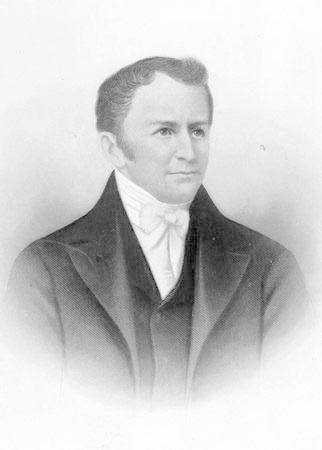
Thomas Worthington, future governor of Ohio
St. Clair and his Federalist allies feared the actions of Congress would lead to the creation of a state government covering the whole new eastern district, which would fall under the control of Democratic-Republicans.  At the next meeting of the Territorial Assembly in December 1801, the Virginians found themselves out-voted.  St. Clair, as historian Donald J. Ratcliffe writes, “bought off some opposition leaders by offering them jobs, appealed to the self-interest of different power centers in the territory, and thereby ensured that the ... assembly would be more amendable to his wishes.”  The new Federalist majority in the assembly revived St. Clair’s division plan.  The assembly passed a resolution on December 21st that called on Congress to divide the new eastern district into two future states, with the Scioto River as the dividing line.  St. Clair and the Federalists were attempting to drive a stake into the fortunes of the Scioto Valley and the ensuing anger in the Virginia Military District quickly boiled over.

It was this vote that led a mob of settlers to take to the unpaved streets of Chillicothe for two nights, culminating in a doorway confrontation with Governor St. Clair in the halls of a local tavern, where the Governor had taken up temporary residence.  On the first evening, Thomas Worthington attempted to restrain the mob’s leader, a young lawyer, Michael Baldwin.  The fiery Baldwin was a native of Connecticut, who had familial ties in the American South (his older brother was a US Senator from Georgia).  With a letter of recommendation addressed to Nathaniel Massie, Baldwin quickly aligned with the Virginian partisans.  To some he was a demagogue of the worst stripe.  To his supporters, who he affectionately called his “Bloodhounds,” Baldwin was the champion of the common man.   In a confrontation outside one of the town’s taverns, and witnessed by numerous people, Worthington told Baldwin that if he attempted any violence on the Governor that he would “prevent it at the risque of his life, and would go and fetch his weapon, and if said Baldwin went there, he would kill him the first person.”  This warning apparently worked, but the following night, Baldwin was again at the head of a drunken and enraged mob and this time he and others forced open the Governor’s door.  Jonathan Schieffelin, a St. Clair ally from Wayne County who was boarding with the Governor, pulled out a pair of “loaded pistols and drove them back into the street.”

The clash between the “Bloodhounds” and the Governor has drawn the attention of a number of historians.  Most recently, Andrew Cayton remarked that:  “These incidents were not simply some episodes of frontier violence or rowdiness; rather, they were symptomatic of the profound confusion in the Ohio Country over the nature of social relationships and political processes. In the absence of legitimate (meaning widely accepted) authority, all persons or groups were left to assume that role themselves.”  While Cayton appears to differentiate the clash in Chillicothe from a simple “episode of frontier violence,” his explanation – the absence of legitimate authority – is one of the primary conditions that helped generate episodes of frontier violence and disorder.  The Chillicothe mob was both revolutionary in character – taking place during the so-called “Ohio Revolution,” and the result of conflict rooted in the frontier character of the Scioto Valley.

The unruly actions of the Chillicothe partisans led the Federalist majority in the Assembly to introduce a measure that would move the territorial capital back to Cincinnati, a town (with its own record of drunkenness, violence, and disorder) that many Federalists nevertheless viewed as more refined, civil, and orderly.  Before adjourning, the Federalist majority also succeeded in electing Judge William McMillan of Hamilton County, as the new Congressional delegate.  The Chillicothe Junta’s ally, William Henry Harrison, had resigned to become the new governor of the Indiana Territory.  McMillan soon left for Washington to lobby Congress to approve St. Clair’s Scioto division.  Chillicothe interests held a public meeting and raised money to once again send their own team of lobbyists to the national capital.  They chose an unlikely pair, considering recent events.

Thomas Worthington found himself traveling eastward on horseback along the new Zane’s Trace with the Michael Baldwin at his side. Their mission was to have the new Republican controlled Congress, once again, reject St. Clair’s proposed division and, instead, authorize the calling of a special convention in the recently shrunken North West Territory, to be held at Chillicothe, wherein the inhabitants of the territory would vote on whether to create a state government.  If the delegates voted in favor of statehood, Congress would authorize the convention to adopt a state constitution.  McMillan did his best, but his arguments in favor of the land division found few supporters in Congress.  Meanwhile, back in Ohio, Federalist control of the Territorial Assembly proved short-lived; their attempt at thwarting the interests of the settlers in the Scioto Valley would fail.  The Virginia Congressional delegation would champion statehood legislation for an Ohio that would have Chillicothe as its first capital.  And they would be victorious.

Statehood, however, did not bring an end to the county seat wars.  As we will see in the next post,  speculation in Virginia Military District lands would be the source of conflict in the newly created Highland County.  And, this time, rather than the interests and plans of Nathaniel Massie, it would be those of his younger brother, Henry Massie, which lay at the heart of the controversy.

Tuesday, December 15, 2009

The Adams County Seat Fight

What follows is another revised section of the conference paper I presented at the University of Dundee in July 2009. We pick up the story of the role land speculation played in generating frontier lawlessness in the Lower Scioto Valley. The signing of the Greenville Treaty of 1795, opened the era of American settlement in the valley and led to a series of conflicts over the location of seats of government. Here we turn our attention to the county seat fight in Adams County. In future posts, we will examine the dispute over locating the territorial and state capitals in Chillicothe and the Highland County Seat Fight, which culminated in a bloody melee in the streets of New Market. ~ ALF


Following the Greenville Treaty of 1795, the rapid settlement of Chillicothe and its environs, along with the further settlement of Manchester (Massie’s original town speculation in the Virginia Military District), and the founding of Alexandria at the mouth of the Scioto River, necessitated the creation of local territorial government in the Lower Scioto Valley. With the lands on the eastern side of the Scioto closed to sale by the US Congress, the Scioto Valley was cleaved in half, with settlement and economic development first concentrated on what became known as the “West Side” of the Scioto. Under the Northwest Ordinance of 1787, the territorial governor had the power to establish the boundaries of new counties and the location of their seats of justice. These executive powers quickly became the source of conflict in the years following the Greenville Treaty.

The Creation of Adams County


In July 1797, Winthrop Sargent, the Territorial Secretary, acting in place of Governor Arthur St. Clair, who was absent the North-West Territory, proclaimed the creation of Adams County, which encompassed much of the eastern section of the Virginia Military District, along with lands on the eastern side of the Scioto. The county included the first three major settlements in the valley – Manchester and Alexandria on the Ohio River and the booming town of Chillicothe to the north. The fortunes of the settlers and speculators of the new Adams county now turned on the establishment of seats of government and locating of new county boundary lines.

The Adams County Seat Fight: Manchester Partisans versus the Up-River Faction

When creating the county, Sargent also appointed all of the county officials – from the Justices of the Peace, to the clerk of the Court of Common Pleas to the County Sherriff, among other lesser offices. Sargent’s proclamation authorized David Edie, the Sherriff, to choose a temporary seat for the court’s inaugural session in September, after which the Territorial Governor would establish a permanent location. Thus, according to Edie’s order, the first meeting of the court was held in Manchester on 12 September 1797.


Thanks to Google Earth, here's a satelite image of modern day Adams County, with the locations of Adams County's various county seats.  West Union became the permanent seat in 1804.

Just prior to this first meeting, Sargent appointed a special commission to select the permanent site. Chosen from the county’s newly appointed officials. Nathaniel Massie (Justice of the Peace and Justice of the Court of Common Pleas), John Beasley (Justice of the Peace and Justice of the Court of Common Pleas), John Belli (Justice of the Peace, Justice of the Court of Common Pleas, and County Recorder), and John S. Wills (Prothonotary of the Court of Common Pleas and Clerk to the Court of General Quarter Sessions of the Peace), four of the region’s largest land speculators, were given the authority to select the site, operating under certain restrictions. Sargent expressly forbid the selection of Manchester, Chillicothe, or Alexandria, indicating a preference for a site at or up-river from the mouth of Ohio Brush Creek. Except for Massie, the commissioners were all Federalists. John S. Wills, a lawyer and land speculator who lived in Cincinnati, led the so-called “Up-River” faction.

The Town of Adamsville

On the 26th of December, 1797, based upon what Sargent described as the “majority” opinion of the special commissioners, he issued a proclamation establishing the permanent seat of justice, up-river from Manchester, at the mouth of Stout’s Run. The town’s official name was Adamsville, but the Manchester faction would call it “Scant,” for the lack of any structural improvements, excepting a hastily constructed log cabin courthouse. Massie and his allies viewed the selection of Adamsville as a transparent attempt to thwart their interests and undermine the influence of Virginians in the Scioto Country.

When the Court met for the first time in Adamsville, in December 1797, the Massie faction boycotted the meeting. By the June 1798 meeting of the Court, the various Justices of the Peace who favored Manchester had settled upon their strategy; they would introduce a motion to accept offers of land for the erection of a courthouse and jail. Five offers were made and after much debate, a majority of the JPs voted to accept Massie’s offer of one acre of land in Manchester. Thus, a new and broader majority of county officials voted to return and fix the county seat at Manchester.

Governor St. Clair Intervenes

The fight over Adams county’s seat of government had really only just begun. When news of the Court’s decision reached Governor St. Clair, he was incensed. He quickly wrote a letter to Massie, who had served as the presiding judge during the June meeting. “The power of fixing the places where the courts are to be held in every county is exclusively in the Governor,” explained St. Clair. “It is an exercise of executive authority of which no other person or persons is or are legally capable; and it is important to the people that the places where they have been appointed to be held should not be subject to wanton change.” The capital investments and the hard earned fruits of settlers’ labor -- their larger fortunes -- were at stake. “When the people lay out their money in improving county-towns,” St. Clair continued, “it is in confidence of their stability; and, when the courts are removed from those towns their importance is lost, and the property of the adventurer sinks with it, and it is to them a real breach of public faith.” He accused Massie and other Adams County JPs of “a most unwarrantable assumption of power and contempt of authority by the justices, which might subject them to prosecution.”

St. Clair charged the Manchester JPs with pursuing their own private interests. “In the situation of a county town a Governor can have no private interest of his own to serve, but,” explained St. Clair, “it is very possible that even a majority of persons who may have been appointed justices may have such interests, and be disposed to prefer them to those of the public at large.”

The Town of Washington

In September 1798, due to Adamsville’s tendency to flood and a pending lawsuit involving the title to the land upon which the town had been located, St. Clair overruled the Court’s decision in favor of Manchester and ordered the courts to meet at a new location at the mouth of Ohio Brush Creek. There, another new town would be platted on the lands of Noble Grimes, and named Washington. Grimes and his family had immigrated to Ohio from Pennsylvania in 1796. He had purchased title to a thousand acres at the confluence of Brush Creek and the Ohio, and emerged as a leading Federalist and opponent of the Manchester faction.

Massie and others balked at St. Clair’s orders and their outright defiance led the Governor to strip Massie and another JP, William Goodin, of their judicial commissions in October 1798. St. Clair and Sargent claimed that the two men “had Misdemened themselves in the execution of their office by attempting to disturb the regular administration of Justice by adjourning the sessions of the said Courts ... to meet at Manchester where they had been duly & regularly appointed to be held thereafter at Washington and fixed at that place by a Proclamation of the Governor.” Stripped of his local governmental power, Massie did not give up on his Manchester speculation. He, along with his allies in the VMD, would seek redress in the new Territorial Assembly and, if necessary, from Congress. The issues involved in the struggle over the location of the Adams County seat would be at the heart of the controversy between Republican forces in the VMD and Governor St. Clair and his Federalist allies.

The First Territorial Assembly and the Clash Over County Boundaries and Seats

The rapid growth in population in southern Ohio led to the creation of the first Territorial Assembly in 1799, through which Nathaniel Massie and other Virginians attempted create new county boundaries and seats of local government. The focus of Virginian interests in Ohio now shifted to the new Territorial Assembly. The election of the first Assembly in 1799 allowed frontier Ohioans to assert local government powers that had previously been claimed by the Territorial Governor. While the governor continued to have the power to create new counties and appoint the locations of their original county seats, the new assembly claimed that they had the power to redraw existing county boundaries and relocate existing county seats. As Andrew R. L. Cayton has argued, the devolution of power to the county officials or to the new Territorial Assembly would “forfeit all the efforts of the Federalist hierarchy to increase the power of the national government in the Northwest Territory.”

In October 1799, the Assembly, to which Massie had been elected, passed a resolution fixing the Adams county seat at Manchester. St. Clair then vetoed the bill and hatched a plan to divide the territory in such a way that the speculative schemes of Massie and others in the VMD would be forever ruined. Frustrated at the local and territorial levels, the Virginians and their allies would turn to the US Congress to block St. Clair’s plans and thereby advance their own interests.

Thursday, October 1, 2009

Nathaniel Massie and the Paint Creek Fight of 1795

The story of Nathaniel Massie, which I began in the last post, is picked up here in another excerpt of the paper I presented at the University of Dundee in July 2009. Additional excerpts of this conference paper will be posted in the coming weeks. ~ ALF


Surveying the lands of the Scioto Valley may have been legal under American law in the spring of 1795, but the Shawnee and others, at the time, did not recognize American surveying rights to these lands. The pan-Indian alliance of Ohio Indians that had recently been defeated at the Battle of Fallen Timbers had yet to sign a peace and land cession treaty. Leaders of the Indian nations, however, were in council with American Indian commissioners at Ft. Greenville. General Anthony Wayne had proclaimed a truce for the purposes of negotiating a treaty, allowing the representatives of the different parties to travel unmolested to and from Ft. Greenville, the location of the council.


The only known illustration of the Paint Creek Fight was published in John McDonald's Biographical Sketches in 1852.


In late May of 1795 towards the end of the council, Virginia land speculator Nathaniel Massie led an expedition aimed at surveying lands on Paint Creek, a major tributary of the Scioto River. Massie planned to locate the site for a new town, which would become known as Chillicothe. Massie and his men, however, ran into a band of Shawnee who were camping on Paint Creek, an area that had long been a popular Indian hunting ground.

Massie and the other leaders of their party decided to attack in a surprise and pre-emptive manner. In their attack, Massie’s party killed a handful of Indians and then pillaged their camp grounds. Massie and his men quickly looted all the Shawnee possessions they could carry and then began a rapid retreat back to Manchester. Once safely back in their stronghold, Massie and others piled their treasure into boats and floated down to Maysville, Kentucky, where they auctioned off $500 worth of booty to the highest bidders in broad daylight. In retaliation for the fight on Paint Creek, the leader of the Shawnee who had been attacked, a man named Pucksekaw – known in English as the Jumper – led warriors into the mountains of western Virginia, where they carried out raids on new settlements, ultimately taking four Americans captive.


The Paint Creek Fight occurred near Bainbridge, Ohio, at what became known as Reeves' Crossing in Ross County, Ohio.


Massie’s attack on Paint Creek and Pucksekaw’s retaliatory raids threatened to derail the peace negotiations that were then underway at Ft. Greenville. Chief Blue Jacket, himself, and a handful of other prominent Shawnee leaders agreed to temporarily leave the negotiations in order to track down Pucksekaw and return him and his captives to Ft. Greenville. Blue Jacket’s efforts were successful; Pucksekaw agreed to bury the hatchet and return his newly acquired captives. Massie, however, had earned the wrath of Arthur St. Clair, who served as the Governor of the North-West Territory. St. Clair considered prosecuting Massie for his actions, but the matter was soon dropped, when St. Clair found it difficult to secure witnesses willing to testify against Massie. With the peace finally secured, Massie’s speculation ultimately paid off; the lands at the confluence of Paint Creek and the Scioto would end up in his hands; his major town speculations would now involve Manchester in the southern region of the Virginia Military District and Chillicothe in the eastern section of the District.

The new frontier town of Chillicothe, located amidst the ruins of ancient Indian earthworks in a bend of the Scioto River, was on the very eastern edge of the Virginia Military District, surrounded by fertile Scioto River bottomlands, which beckoned American settlers from Kentucky, Virginia, Maryland, and Pennsylvania. Chillicothe, named after the Shawnee word for their principle town, was also centrally located within the lands ceded by the new Greenville Treaty; Nathaniel Massie’s newest town speculation was quickly perceived far and wide to be the future center of frontier life in Ohio.

Monday, September 7, 2009

Land Speculation and Lawlessness

This past July I presented some of my recent research on the history of the Lower Scioto Valley at an international conference, hosted by Dr. Matthew Ward at the University of Dundee in Scotland. The Conference was entitled, “From Borderland to Backcountry: Frontier Communities in Comparative Perspective” and the title of my talk was “Land Speculation, Lawlessness, and the Establishment of Seats of Government in Ohio’s Scioto Country, 1783-1807.” The conference captured the renaissance of international scholarly interest in Ohio Valley frontier history and brought together scholars from as far away as South Africa, Australia, Canada, Germany, the United Kingdom, and the United States, including three other historians from state universities in Ohio (Cleveland State, Kent State, and Ohio State).

I’d like to thank Tim Scheurer, Dean of Arts & Sciences, and Shawnee State University’s Faculty Enrichment Fund Committee for funding the research and presentation. Martin McCallister of the Natural Areas and Preserves Division of the Ohio Department of Natural Resources also deserves special thanks for facilitating a “research” hike to Raven Rock.

Below is the introduction to my talk; excerpts from the paper will follow in future posts.

~ALF

Land Speculation and Lawlessness on the North American Frontier

In the 1780s and 1790s, in the newly independent United States of America, Virginians possessed long-standing, as well as newly awarded land bounties, issued at various times as compensation for colonial or revolutionary era military service. Virginians looked to the Scioto Valey in south-central Ohio as their Promised Land, where their family’s fortunes were to be made and their independence and liberties secured. Many obstacles, however, stood in their way. First and foremost, the determination of the Shawnee (and other Ohio Indians) to maintain possession of their lands north and west of the Ohio river posed the most immediate hindrance to the designs of Virginia veterans and other land speculators who sought their fortunes in the Scioto Valley.

Only the extinguishment of Indian land claims to the region would allow for the legal (though not necessarily orderly) survey, sale, and settlement of the region. In frontier regions, where new administrative boundaries were being run and seats of government located, large land and town speculators, with the backing of yeoman farmers and other urban settlers, sought the powers of local, state, territorial, and national governments to secure their community’s fortunes and forward their own speculative ventures.

Land speculation’s role in the development of the American West has long been a subject of debate amongst historians. The western land jobber has been cited as a primary factor in the inequitable distribution of land, which stifled social mobility and frustrated economic development. The speculator, however, has also had his champions, those who view these businessmen as the main drivers of economic development. Still others have argued that large landowners had their speculative schemes frustrated by liberal federal land policies, which ensured that middling settlers could purchase smaller tracts of land at affordable prices and with generous credit options. Historians have been primarily interested in the speculators’ role in the development or frustration of democratic institutions and their role in the emerging national market economy. Although Woody Holton and others recent work has drawn scholarly attention to the role of Virginian land speculation in the Ohio Valley in generating conflict between Indians, colonists, and British officials, greater attention to the role speculation played in generating episodes of frontier violence and lawlessness is needed. Attention to the relationship between frontier speculative ventures and lawlessness suggests that Indian-settler violence, as well as settler-on-settler violence, sprang from a rapidly growing American population’s pursuit of personal gain, which manifested itself in a thirst for cheap, productive land.

Speculative ventures, large and small, in the Trans-Appalachian West combined with the weakness of governmental authority on the frontier to generate significant lawlessness and violence, and, paradoxically, the same interests in personal gain also led frontier settlers and eastern speculators to seek the powers of government in order to pass laws protecting and promoting their investments. The high stakes nature of frontier land and town speculations, however, meant that local, state, and national authorities found it difficult to always maintain law and order and restrain conflict to the orderly confines of governing institutions.


The Virginia Military District, established in 1784

Thanks to the influence of Virginians in the Confederation Congress, the veterans of Virginia, along with allied land speculators, succeeded first in securing their prior land claims north of the Ohio River through the creation of the Virginia Military District (VMD) in 1784. The cession of Virginia’s larger land claims in the region and the federally guaranteed reservation of millions of acres of lands in an Ohio VMD unleashed the speculation of thousands of Virginians and generated a new round of lawlessness and disorder. Virginians and their allies would go on to harness the powers of the new federal government to officially extinguish Indian land claims in the region. Federal troops with the assistance of frontier state militia forces defeated the Shawnee and other Indian nations, forcing, at the barrel of a gun, the cession of their lands in southern Ohio. It was then, in the 1790s, that speculation-related struggles over new administrative boundary lines and seats of government began to generate still another stage of lawlessness and disorder in frontier Ohio.

Although lawlessness and violence are found in all societies and eras of history, scholars studying the development of the United States have long cited lawlessness and its offspring – violence – as a central characteristic of frontier life. Indeed, a central part of the telling of the story of western settlement has been the violent struggle to establish the supremacy of law and the authority of civil government.

Nathaniel Massie, Pioneer Land Speculator

Let us start with Nathaniel Massie, the largest land and town speculator in the Virginia Military District. The VMD had been promised to Virginians who had fought in the Continental Army during the Revolutionary War. Virginians had signed up and fought against the British and their Indian allies for various reasons, but one of these was in order to establish land speculations on lands that were still controlled by Ohio Indian nations. Through their representatives, Virginians agreed to give up much of their larger claim to lands in the trans-Appalachian West in exchange for clear titles to claims in the Scioto Country. And they did this at a time when the Indians of the region had not yet ceded these lands to the new United States of America.


Nathaniel Massie (1763-1813)

In 1783, at the age of nineteen, Nathaniel Massie set off for Kentucky in search of his fortune. With the assistance of his influential father -- a large slave and plantation owner, Anglican vestryman, captain of the militia, and a Justice of the Peace in Goochland County, Virginia – Massie would eventually secure a clerk’s position in the office of Gen. Richard C. Anderson, the Surveyor-General for Virginia military lands in the Appalachian west. Operating out of the Louisville, Kentucky area, Massie would soon join in the surveying of Virginian lands in the Scioto Valley.

After the 1784 cession, but before the new American government had established peace treaties and land cessions with the Indian nations of Ohio, squatters from Virginia and other eastern states began settling on the northern side of the Ohio River, at the mouths of the various tributaries of the Ohio River. Federal troops were dispatched to ward off the squatters and burn down any of their buildings in an effort to secure peace negotiations with the Shawnee, who still inhabited and claimed the Scioto country as theirs. In 1785, American Indian Commissioners threatened a handful of Shawnee leaders with the “destruction of your women and children” if they would not sign a treaty extinguishing Shawnee land claims in southern Ohio. Moluntha, an aged civil chief, prevailed upon his fellow Shawnee to accept the treaty; in fear of their destruction, they signed what became known as the Treaty of Ft. Finney. Colin Calloway has written that many of the Shawnee “who did not attend the conference were outraged by the terms, scorned those who accepted them, and repudiated the treaty.” A year later, in 1786, after what Americans considered Shawnee violations of the treaty, a militia force from Kentucky crossed the Ohio destroyed Shawnee villages and killed the peaceful Shawnee leader Moluntha. Then, the following year, in June of 1787, acting on intelligence that pointed to an impending Indian raid into Kentucky, three hundred Kentuckians, under the command of Col. Robert Todd, invaded the Scioto Country in search of marauding bands of Shawnee warriors. Todd’s forces briefly engaged a group of Indian warriors on Paint Creek, leading many Indians to evacuate the larger Lower Scioto Valley.

Indian resistance to the American settlement of southern Ohio continued; the Ft. Finney peace treaty lay in Moluntha’s grave and a state of war now largely existed between the United States and an alliance of Indians nations who no longer or who had never recognized the legitimacy of the Ohio land cession treaties.

In the wake of Todd’s Campaign, the first official land surveys in the Virginia Military District were completed in the late summer and fall of 1787. At this time, it appears that Massie conducted his first surveys at the confluence of Paint Creek and the Scioto River, the future site of his greatest town-speculation, the city of Chillicothe. In July 1788 Congress suspended the surveying of the VMD over the objections of Virginia’s congressional delegation. The suspension had the backing of New England and New Jersey land speculators, who had invested capital in lands on either side of the VMD – the Symmes Purchase area centered around Cincinnati in the west and the Ohio Associates’ Purchase centered around Marietta in the east. The surveying and sale of lands in the VMD undermined the financial interests of those speculators involved with Symmes and the Ohio Associates, as well as the new Federal Government, which sought much needed revenue in the sale of Western lands.

After three years, the surveying suspension was lifted in August 1790. The surveying activities of the Virginians, along with other encroachments on to lands claimed by Ohio Indian nations, would then become the primary cause of Indian attacks on American surveyors and settlers in the late 1780s and early 1790s. The Indian raids involved extreme physical violence, hostage taking, and horse thefts, which, in turn, generated a series of military operations against the Indian inhabitants of the larger Ohio Country.


View from Raven Rock, Scioto County, Ohio (June 2009)

In March 1790, four months before Congress re-opened the VMD, a band of Shawnee and Cherokee warriors set up camp near the mouth of the Scioto River. From their lookout atop Raven Rock on the West Side of the Scioto’s mouth, the warriors could look up and down the Ohio River for a dozen miles. The vantage point gave the Indian warriors time to set up ambushes at the confluence of the Scioto and Ohio Rivers. Much property was taken and numerous men, women, and children were killed or taken captive (some accounts place the number over 100).

In response to these and other “provocations” in the larger Northwest Territory, the Washington administration would order federal military operations against the Indians of the Northwest Territory in the 1790s. The first major campaign launched against the Ohio Indians by the new federal government was aimed at eliminating the Indian threat in the Scioto Valley and at its mouth, to ensure the safety of American settlers headed to Ohio and Kentucky and beyond, down into the Mississippi Valley. In April 1790, in a largely forgotten campaign, Secretary of War Henry Knox authorized a military operation against the Indians at the mouth of the Scioto. Led by Gen. Josiah Harmar, the first Federal campaign into the Scioto Country did not lead to any great victory or defeat. By the time US forces arrived in the Scioto Valley, the Indian warriors had abandoned their position and retreated from the area.

Attacks at the Mouth of the Scioto appear to have stopped following Harmar’s Scioto Campaign, thus clearing the way for Virginia surveyors and speculators to enter the VMD. In April 1791, a group of immigrants, drawn largely from Kentucky, established the first American settlement in the VMD. The settlement, planned and organized by Nathaniel Massie, originally entailed a stockade and was known as Massie’s Station. Under what they believed to be the constant threat of Indian attack, Massie and his associates launched clandestine surveying parties deep into the Scioto Valley. As more settlers arrived, Massie would survey lots and plat a town; nearby lands would be cleared for farming. Massie’s Station would become the town of Manchester.

While Massie and his assistants surveyed the VMD, a confederation of Indian nations fought a series of battles with the forces of the US Army and regional state militiamen. The culmination of this fighting came in 1794 at the Battle of Fallen Timbers, where American forces under the command of General Anthony Wayne defeated the Indian alliance. Many of the future settlers of the Scioto Country saw service in these campaigns and when the peace had been secured they and thousands of others from Virginia and other eastern states descended upon the Scioto Valley like a host of locusts.

Some Virginians, however couldn’t wait for the treaty to be negotiated and signed. In their minds, after Fallen Timbers, all that was left undone was the legal rigmarole of a peace treaty council. Much of the best lands in the VMD had not yet been surveyed. Future town sites had not yet been platted. During the lengthy council, which was held at Ft. Greenville in western Ohio, all sides in the conflict had proclaimed a truce. The peace process, however, was nearly derailed when Virginian surveyors led by Nathaniel Massie violated this truce.

Saturday, December 20, 2008

Flora and Fauna

The Impact of American Settlement on the Ecosystem of the Lower Scioto Valley

This past May the Heartwood Forest Council invited me to address their annual meeting, which was held at Camp Oyo in the Shawnee State Forest. Cheryl Carpenter, the founder of Voices for the Forest, a local organization dedicated to protecting the health of the Shawnee State Forest, helped organize the event and suggested that I speak on some aspect of local environmental history. What follows is an essay based on my Forest Council talk, a first stab of sorts into the environmental history of the Lower Scioto River Valley. Its focus concerns the impact of American settlement on the flora and fauna of the region.

Today, when one visits the Shawnee State Forest and hikes along its ridges and through its hollows, one can easily imagine they have stepped back in time to an era when southern Ohio was still home to the Shawnee and other Ohio Indians. The sounds of modern American civilization fall away until all that you are left with are the sounds of the forest -- the song birds, the bugs, the rustling of the underbrush by a nearby deer, the call of a wild turkey, the wind through the trees, the water gurgling over rocks, the sound of the occasional tree limb falling. This visual and aural illusion is fleeting as it is eventually shattered when a plane flies across the sky, or when a truck drives by on one of the forest’s many roads, or when one comes across the scarred land of a recent clear cut.


Crossing a dry run on the Shawnee State Forest Day Hike Trail (August 2008)

The illusion is not only fleeting, it can leave the hiker with a false sense of what the sounds and sights of the region’s forests would have actually been like at the dawn of nineteenth century. There is no recovery of the old original growth forest; the forest has forever changed; the flora and fauna of its ecosystem has irreversibly been transformed. Even in the most remote sections of the forest, where this illusion can be its strongest, the sights and sounds are now different from what they would have been in the 1790s.

So what has changed? What has been lost? What impact did American settlement have on the animal and plant species of the Lower Scioto River Valley?
~ ALF


The rapid American settlement of the Valley at the beginning of the nineteenth century inaugurated a new chapter in the region’s natural history. The flora and fauna of the Scioto would never be the same. Farming, tanning enterprises, and charcoal-fired industries would destroy the largely virgin forests of the valley, forever altering the habitat of the region’s animals. Some species would be extirpated as nuisances, others would be over-hunted until they disappeared from the Valley, and in some cases, such as with the Carolina parakeet and the passenger pigeon, until there were no more to be found anywhere. The American settlement of the Scioto Valley would lead to massive deforestation and contribute to the extirpation and extinction of a number of animal species.

The forests of the 18th century and before swarmed with wild life and left its first American visitors in awe. James B. Finley, one the first settlers in the valley in the late 1790s recalled his first trip into the Scioto Country:
It would be impossible for me to describe the beauty 
of these rich bottoms. The soil itself for richness was 
not exceeded by any in the world. The lofty sugar [maple]-tree, 
spreading its beautiful branches; the graceful elm, waving 
its tall head, the monarch of the forest; the black and 
white walnut; the giant oak, the tall hickory; the cherry 
and hackberry; the spicewood, with its fragrance; the 
pawpaw, with its luscious fruit; the wild plum; the rich clusters of grapes, which, hanging from the massy vines, 
festooned the forest; and, beneath all, the wild rye, green 
as a wheat-field, mixed with the prairie and buffalo clover — 
all formed a garden of nature most enchanting to 
behold. The clear and beautiful rivulet creeping through 
the grass, and softly rippling over pebbly bottoms, the 
gentle zephyrs [breezes] freighted with nature's incense, pure and 
sweet, regaled our senses, and filled us with delight. All 
nature had a voice which spoke most impressively to the soul; and while all the senses were pervaded with an unutterable 
delight, the solemn stillness seemed to say, God
reigns here. The song of the lark and nightingale, the melancholy wail of the dove [passenger pigeon] or whistle of the whippoorwill, 
the low hum of the bee, the chirping of the grasshopper, 
the bark of the squirrel, the drumming of the pheasant, 
the bleat of the fawn, the growl of the bear, the hoot of 
the owl, the howl of the wolf, the scream of the panther, 
and the yell of the Indian, were all that broke the silence 
in this deep and beautiful forest.


The reign of God, like the reign of the Shawnee and other Indians, however, was coming to an end. Within a generation, man, more particularly, Homo Americanus, let’s call him, would claim dominion over the valley and its flora and fauna. The animal species that would soon disappear included some of those mentioned by Finley, such as the passenger pigeon, white-tailed deer, wolf, black bear, and panther. But others he failed to mention would also be extirpated, such as the American Bison and the Carolina Parakeet.

The bottomlands of the river, for instance, that were once populated with massive, hundred or more year old sycamores, would be cleared for the planting of corn. While sycamores can still be found along the edges of the Scioto, the Ohio, and the smaller tributaries of the region, such as Turkey Creek, the ancient giants are gone.

One traveler who passed through the Valley in 1807 noted the following in their journal: “The river meanders through an extensive alluvial bottom of the richest quality of land. In the low, inundated bottoms, the timber is mostly cottonwood [or more commonly known as poplar] and sycamore, some of them very large; in the high bottoms, black walnut, ash, and sugar maple prevail, with pawpaw.” This last reference, that of the pawpaw to which James Finley also referred, is to a North American tree of the custard apple family, with purple flowers and edible oblong yellow fruit with a sweet pulp. Pawpaw, which can still be found in the Shawnee State Forest, was once found in large thickets along the banks of the Scioto and the Ohio – at one point in time a massive thicket lined the river, where Portsmouth now stands.

Another traveler, who visited the Scioto Valley just after the War of 1812, nearly twenty years after the first American settlers began clearing the land, noted remnants of the ancient forest and experienced the same sense of time travel that hikers can experience even today:

… in the rich bottoms [the trees] sometimes exhibit a grand assemblage of gigantic beings, which carry the imagination back to other times, before the foot of a white man had touched the American shore. Yesterday I measured a walnut tree almost seven feet diameter, clean and straight as an arrow; and just by were rotting, side by side, two sycamores of nearly equal dimensions. The sycamore grows in bottoms [that frequently flood], to an unwieldy bulk; but the white oak is the glory of the upland forest. .... [The oaks] have rarely an opportunity of swelling out to a large diameter, owning to their crowded growth. They are, for the same reason, very lofty, straight, and clear in their stems; sometimes eighty or ninety feet without a branch. I measured a white oak, by the road side, which, at four feet from the ground, was six feet in diameter, and at seventy five feet measured nine feet round, or three feet in diameter.


The thinning of the sycamore is believed to have contributed to extirpation of the Carolina Parakeet.

Considered the largest deciduous tree species in North America, the sycamore was the source of food and nesting for a species of birds that once populated the Valley, but is no more. The Carolina Parakeet once called the Scioto Valley home. Amongst the stone pipes unearthed in the Tremper Mound, which is located near the mouth of the Scioto, on the West Side, were pipes depicting the green-bodied, yellowed-headed parakeet. When Fortescue Cuming visited Portsmouth in 1808, he noted large flocks of the birds, which “when they alight on a tree, they are not distinguishable from 
the foliage, from their colour.”


A sycamore reflected in the waters of Wolfden Lake, Shawnee State Forest (November 2008).

The giant sycamores, many of which had been hollowed out by decay were favorite nesting and roosting sites for the Carolina Parakeet. A single, large tree cavity would be the home of numerous birds. The sycamore also provided one of the bird’s favorite foods before the arrival of the Americans. The seed balls of the sycamore, along with the seeds of the cocklebur were a primary source of food for the bird. With the arrival of the Americans, however, the parakeets developed a fondness for apple and pear seeds, which were found in abundance in the newly planted orchards of the Americans. To the great consternation of the new settlers, the birds would destroy the fruit in order to get to the seeds; a flock of parakeets could wipe out a whole season’s fruit crop in little time. The birds also appear to have devoured corn, particularly when it had been cut with its stalks and stacked in piles, a common practice of the region’s cattle farmers. The decline of the parakeet coincided with the destruction of sycamore of the ancient forest, but the spread of cocklebur (a weed that flourished in newly cleared land) may have made up for the loss of sycamore seed balls.


Audubon's painting of the Carolina Parakeet

The thinning of sycamores had its greatest impact on the destruction of roosting and nesting sites. One theory about the destruction of roosting and nesting sites includes a role for European honeybees, which moved westward in advance of American settlements. The bees themselves may have displaced the parakeets by taking over hollow trees. Then when the Americans arrived they sought out these hollowed out trees, chopping them down in search of honeycomb. While habitat destruction clearly played a role in the extinction of the Carolina Parakeet, the birds were also hunted, but unlike the passenger pigeon, which was hunted for food and for which there was significant market demand, the parakeet because of its smaller size and its less tasty meat, and its appetite for apples, was hunted as a nuisance, simply exterminated.
John James Audubon, the great American naturalist and artist, noted in 1831 that:

The parrot does not satisfy itself with Cockle-burs, but eats or destroys almost every kind of fruit indiscriminately, and on this account is always an unwelcome visitor to the planter, the farmer, or the gardener. The stacks of grain put up in the field are resorted to by flocks of these birds, which frequently cover them so entirely, that they present to the eye the same effect as if a brilliantly colored carpet had been thrown over them. The cling around the whole stack, pull out the straws, and destroy twice as much of the grain as would suffice to satisfy their hunger. They assail the Pear and Apple-trees when the fruit is yet very small and far from being ripe, and this merely for the sake of the seeds. As on the stalks of corn, they alight on the Apple-trees of our orchards, or the Pear-trees in the gardens, in great numbers; and, as if through mere mischief, pluck off the fruits, open them up to the core, and, disappointed at the sight of the seeds, which are yet soft and of a milky consistence, drop the apple or pear, and pluck another, passing from branch to branch, until the trees, which were before so promising, are left completely stripped, like the ship water-logged and abandoned by its crew, floating on the yet agitated waves, after the tempest has ceased. They visit Mulberries, Pecan-nuts, Grapes, and even the seeds of the Dog-wood, before they are ripe, and on all commit similar depredations. The Maize alone never attracts their notice.

…. The parakeets are destroyed in great numbers, for whilst busily engaged in plucking off the fruits or tearing the grain from the stacks, the husbandman approaches them with perfect ease, and commits great slaughter among them. All the survivors rise, shriek, fly round for a few minutes, and again alight on the very place of most imminent danger. The gun is kept a work; eight or ten, or even twenty, are killed at every discharge. The living birds, as if conscious of the death of their companions, sweep over their bodies screaming as loud as ever, but still return to the stack to be shot at, until so few remain alive, that the farmer does not consider it worth his while to spend more of ammunition. I have seen several hundreds destroyed in this manner in the course of a few hours, and have procured a basketful of these birds at a few shots, in order to make choice of good specimens for drawing the figures by which this species is represented in the plate now under your consideration.


Audubon also sounded the first alarm about the birds impending demise:
Our Parakeets are very rapidly diminishing in number; and in some districts, where twenty-five years ago they were plentiful, scarcely any are now to be seen. …. At the present day, very few are to be found higher [in the Ohio Valley] than Cincinnati….


By the mid-nineteenth century, records indicate that the Carolina Parakeet was only to be found in large numbers in the swamps of Florida. The last of the wild parakeets are believed to have died in the 1920s. One expert on the Carolina Parakeet put it mildly that “the lack of a general sentiment in pioneer society for their protection may have been their downfall.”

Hunting by Americans in the region has also been blamed for the extinction of the passenger pigeon, whose massive flocks once darkened the sky of the valley. In 1813, Audubon recorded an account of a massive migration of passenger pigeons flying south from Ohio across the river into Kentucky:

I observed the Pigeons flying from north-east to south-west, in greater numbers than I thought I had ever seen them before, and feeling an inclination to count the flocks that might pass within the reach of my eye in one hour, I dismounted, seated myself on an eminence, and began to mark with my pencil, making a dot for every flock that passed. In a short time finding the task which I had, undertaken impracticable, as the birds poured in in countless multitudes, I rose, and counting the dots then put down, found that 163 had been made in twenty-one minutes. I traveled on, and still met more the farther I proceeded. The air was literally filled with Pigeons; the light of noon-day was obscured as by an eclipse, the dung fell in spots, not unlike melting flakes of snow; and the continued buzz of wings had a tendency to lull my senses to repose.


Audubon estimated the numbers in the billions. By sampling and measuring the size of this mile-wide flock and the three-day duration of its flow, Audubon concluded that there had been “One billion, one hundred and fifteen millions, one hundred and thirty-six thousand” pigeons flying overhead. The flocks darkened the sky, as if there was an eclipse.

Audubon’s writings (as well as his painting) of the passenger pigeon are quite well known, especially his description of their multitudes. However, if one reads further in Audubon’s account of this incredible migration, we can gain some insight into the eventual extinction of the passenger pigeon.


Audubon's painting of the Passenger Pigeon

After commenting upon their shear number of pigeons flying overhead, Audubon wrote that:

The people were all in arms. The banks of the Ohio were crowded with men and boys, incessantly shooting at the pilgrims, which there flew lower as they passed the river. Multitudes were thus destroyed. For a week or more, the population fed on no other flesh than that of Pigeons, and talked of nothing but Pigeons.


Audubon believed that it would not be the mass slaughter of the birds, but rather the destruction of the forest that would cause the demise of the passenger pigeon, whose range was from Canada to the Gulf Coast, with the Ohio valley (and the Scioto in particular) as its center. In the end, it was both. The pigeon’s habitat was largely destroyed in the 19th century; while their numbers were severely diminished through large scale, over-hunting. By the start of the 20th century, the passenger pigeon was on the brink of extinction. And within a decade it would be extinct, with the last wild pigeon being shot near the banks of the Scioto River in Pike County.

The destruction of the forest in the Lower Scioto Valley would pick up rapidly with the advent of the industrial revolution, as charcoal-fired furnaces were constructed to manufacture, first salt, and then pig iron. Steamboats plying the Ohio, and later railroad locomotives would also consume hundreds of thousands cords of timber. The regions furnaces and steam engines would not covert to coal until the region’s forests had been depleted – the earliest transition to coal began in the Scioto Valley in the second decade of the nineteenth century and the transition would not be complete until the 1870s.

The first manufacturing industry in the valley centered on the production of salt. On Salt Creek, a tributary of the Scioto, which flows south westerly from Jackson County to its confluence with the Scioto in Pike County, Native Americans were the first to boil the saline water for salt production. It was here that Daniel Boone, when taken hostage by the Shawnee, helped manufacture salt in the 1780s. The manufacture of salt would become closely tied to another industry – the meat packing industry. The basis for both of these industries is ultimately agriculture. Farmers in the valley found it profitable to convert much of their grain production into the flesh of animals, which could be driven to the market place or packed in barrels and shipped down river.

Prior to the development of refrigeration technologies, meat was preserved in salt. The by-products of meat-packing became the raw materials for other manufacturing establishments – lard-oil, soap, candles, glue, and other chemical compounds. The hides of the cattle were converted into leather, which was then used in the shoe and harness manufacturing industry. An auxiliary tanning industry also developed, which further impacted the forest, as tanners sought tannic acid in the region’s tree bark.

During the period of greatest production at the Scioto Salt Works, from 1806 to 1808, there were twenty furnaces in operation. These made an average of from fifty to seventy bushels of salt per week. If they were working at capacity – 70 bushels of salt per week – each furnace would have had to boil 46,200 gallons of brine. The furnaces were fired by the combustion of charcoal, which was made from the timber surrounding the various furnaces. Around 1814, the state of Ohio began offering subsidies to salt manufacturers who would use coal, rather than wood to fire their furnaces. The use of coal at the Scioto Salt Works is believed to mark the first application of coal in industry in America and can be cited as one of the beginnings of coal mining in Appalachia.

The second decade of the nineteenth century – the 1810s – also witnessed the first construction of charcoal-fired iron furnaces in the Scioto Valley, and more precisely in Adams County, where iron ore was first discovered in the woods that now adjoin Shawnee State Forest. In the 1820s and 1830s, iron production shifted eastward into Scioto and Lawrence counties, to the area now partially protected by the Wayne National Forest.

A skilled collier, working for one of the region’s furnaces, could turn a cord of wood into forty bushels of charcoal. And it took some four hundred bushels of charcoal (roughly 10 cords of wood) to produce one ton of pig iron. In essence one acre of timber could produce enough energy to process 4 tons of pig iron. The annual consumption of timber per furnace ranged from 50 and 200 acres. “At various times there were from fifty-seven to seventy blast furnaces in southern Ohio with an annual capacity of 142,000 tons of iron.” If the region’s furnaces operated at capacity that would translate into the destruction of some 35,500 of acres of timber per year, at the height of production. Although such a large amount of acreage was probably never consumed a year, even with a conservative estimate of 16,000 acres per year (or 25 square miles of forest), the pre-coal-fired iron industry in Southern Ohio took an immense toll on the Old Growth forests of the region. Consider the size of Shawnee State Forest today, which has over 60,000 acres, which equals about 94 square miles. With my conservative estimate, it would have taken just under four years to clear the present size of the Shawnee State Forest.

The destruction of the forest, combined with over-hunting, also took its toll on the American Bison and white-tail deer of the valley. The extirpation of the Buffalo, of which there were relatively small herds east of the Mississippi compared to those in the West, was completed by 1830. The last killed in Pennsylvania was in 1801, the last in Louisiana in 1803, the last in Illinois and Ohio in 1808; the last sightings in Kentucky came in 1820, in Tennessee in 1823, and in western Virginia in 1825; the last Buffalo in Indiana was shot down by a hunter in 1830. Records suggest that the overwhelming bulk of the eastern herds had been destroyed by the year 1800.


An American Bison herd in Kentucky

The last Buffalo shot in the Scioto Valley was killed by Phillip Salladay in Green Township in southeastern Scioto County around the year 1801. According to local legend, Phillip and his son were hunting on Pine Creek when they came across a solitary buffalo. Phillip took the first shot, which only wounded the animal. The bison turned and charged straight at them. “As the boy was getting his rifle ready to shoot, the father snatched it from him, and killed the buffalo.” The general consensus among scholars who have studied the demise of the Bison east of the Mississippi, its extirpation was the result of over-hunting and the “destruction of their habitat destroyed their range.”

The over-hunting of white-tailed deer and black bear began even before the settlement of Americans in the Scioto Valley. One reason the Shawnee and other eastern Indians had re-turned to the region in the early 1700s was because of the depletion of deer and other game in the East. Indian hunters traded deer and bearskins for European and American manufactured goods. Over-hunting, however, truly began to decimate these animal populations in the Scioto Valley only after American settlement had begun. In the memoirs and journals of the early pioneers, bear meat was a choice meal; bear bacon was used like cash. Their hides also brought in good money. According to one record, between 1805 and 1807, more than 8,000 bearskins were shipped to eastern markets from the Tri-State Region of Ohio, Kentucky, and West Virginia. Many a hollowed-out sycamore and other trees were felled to get at the bears. The shooting of bears accomplished two purposes – it provided much needed meat in early years of settlement, before cattle and swine had come to supply the needs of the settlers, and it removed what many saw as a dangerous wild neighbor.

Deer meat was also a regular staple of the early pioneers and continued for decades to be a source of nutrition in the backwoods of the valley. But, as the forests were cut down, destroying their range and the abundant mast – the acorns and other nuts – that the deer relied upon, their numbers began to dwindle. Considering the large numbers of deer that currently inhabit the Valley (and Shawnee State Forest, in particular), it may be surprising for some to learn that the White-Tailed Deer was actually hunted into oblivion by the dawn of the twentieth-century. According to a local historian writing at about this time:

The whitetailed deer was the last of the big game in Scioto County. They were killed in numbers, as late as the [eighteen] seventies in the region drained by Twin Creek [in what could be described as the heart of the modern-day Shawnee State Forest]. Some were killed in the [eighteen] eighties, but by this time, they were quite scarce. The last deer, killed in Scioto County, was killed on Turkey Creek about 1895.


Turkey Creek, as many of my readers may know, is the creek that runs alongside State Route 125 and feeds Shawnee State Park’s two major lakes – Roosevelt Lake and Turkey Creek Lake.

Just as the deer have returned to the valley and Shawnee State Forest, so have the coyotes that had once been hunted to extirpation. Coyotes that once preyed on the deer and other smaller animals were seen as a great nuisance to the early American settlers of the region. They killed cattle and swine and generated fears over the safety of young children. County governments, such as that of Scioto County, even had bounties for their scalps. The last recorded bounty of $1 was paid out for a scalp in Scioto County in 1831.

So what are we to take away from these chapters in the environmental history of the Lower Scioto Valley? The forest was a critical part of a very delicate ecosystem. The return of the forest has helped bring about the return of certain species. But, others like the Carolina Parakeet and the Passenger Pigeon are gone forever. Once lost, somethings can never be restored.

Tuesday, October 21, 2008

Lower Scioto Valley History Website Launched

Lower Scioto Valley History: Shawnee State University’s Local History Workshop is now on-line. This new website is meant to encourage the study and preservation of local history. I’d like to thank those who helped fund and support the creation of this on-line resource. First, thanks go to Jerry Holt, the former Dean of Arts and Sciences, and Jim Miller, the long-serving chair of the Social Sciences Department at Shawnee State. It was Jerry and Jim who first supported the development of a local and oral history curriculum. With their support I was able to attend the Ohio Humanities Council’s annual Oral History Institute at Kenyon College. Then with the support of two grants from the Ohio Board of Regents’ catalystOhio initiative and the ongoing support of the Department of Social Sciences I and my students were able to conduct oral history interviews and develop other primary source material for the website. Dr. Stylianos Hadjiyannis and Dr. Michael Barnhart, who also received grant money for the project, contributed their know-how in helping me design and develop the website.

The website has oral history interviews, image and map scrapbooks, an archive of primary research documents, and a list of related website links. The interviews include the latest recordings, which focus on the Norfolk and Western Railway Strike of 1978. Earlier interviews focusing on the shoe, steel, and nuclear industries are also available.

In the scrapbook section, highlights from the Harald Daub Collection are also now available. The Daub Collection consists of clippings from the personal scrapbooks of former City Councilman Harald Daub. These highlights focus on Daub’s election in 1979, the controversy surrounding a proposed downtown mall for Portsmouth, and city council’s attempt to fire City Manager Barry Feldman. More highlights covering the successful campaign to recall Daub and other councilmen will be added in the near future. Thanks are due Harald Daub for allowing the presentation of these highlights.

In addition to the scrapbook section of the website, the digital archive section includes copies of historically significant letters, manuscripts, and government documents. As with the rest of the website, new content will be added in the future. Currently, there are only a handful of documents on-line; one of which, known as the “Sears Letter,” dates back to 1981 and involves the proposed downtown mall.

The current controversy over the re-use of the old downtown Marting’s Department Store building for new city offices has marked a return to local politics for Harald Daub. His recent Ohio Election Commission complaint against the Marting’s supporters for false advertising, has generated letters to the editor of the Portsmouth Daily Times that have rehashed Daub’s roll in the Feldman/Mall Controversy of 1980. Did Daub and his supporters kill the mall project, as one recent letter writer claimed? Are they to blame?, as Portsmouth Chamber of Commerce President Michael Gampp suggested in a recent fund raising letter for their pro-Marting’s city building plan. “Our City has been paralyzed for almost thirty years by a group of individuals who wish to use threats and intimidation as tools to further their agenda and silence anyone with a different opinion.”  According to Gampp, “During this time our City has, at best, stagnated and in many ways, deteriorated.  Recalls, mudslinging and personal attacks have not helped our situation.”

The economic woes of Portsmouth since the 1970s have been the primary cause of political upheaval and in-fighting among the city’s residents. Systemic changes in the economy, nation-wide and across the globe, brought de-industrialization to the Ohio valley and Portsmouth like many other river cities has been devastated economically. Blame for the decline has become central to understanding local politics. All parties in the current controversy want what they believe is best for the town, but both sides fix the responsibility of the decline on the other. To some outside observers these divisions have come to be seen as one of the greatest hurdles to reviving the city. A struggle for control of local government and the future of the city is underway and this struggle has its origins in the Feldman/Mall Controversy of 1980.

Highlights from the Daub Collection help shed light on this area of Portsmouth history; although an incomplete record, it is hoped that other documents related to these controversies will be preserved for history’s sake. The scrapbook section of the website is open to submissions from the public. If you have letters, newspaper clippings, or other documents that you’d like to add to a scrapbook, whether on the 1980s Feldman/Mall Controversy, the current quarrel over the Marting’s building, or any other historical event in Portsmouth’s past please consider submitting it for inclusion.

These digital scrapbooks are modeled on the legendary Portsmouth scrapbooks created by Henry A. Lorberg at the turn of the 20th century. The original Lorberg Scrapbooks can be examined in the Local History Department of the Portsmouth Public Library. The new Lower Scioto Scrapbooks are meant to replicate this incredible local history resource, but do it through the latest computer technology.  During the 1890s and first decades of the twentieth century Henry Lorberg went door-to-door collecting items for his scrapbooks.  His multi-volume collection of photos, news-clippings, and other ephemera offers an amazing window into the past. Hopefully, these new digital scrapbooks will help open another window through which we all can come to a better understanding of how we got to where we are today.

With Lorberg's method in mind, the Lower Scioto Valley History website accepts submissions from the public.  Again, I encourage you, if you have an item -- photograph or other type of document of local or regional interest that captures the past or present -- please consider having it placed in one of the project scrapbooks.  To make a contribution, e-mail a digital copy of your item or send a query to me at afeight at shawnee.edu. Free scanning of documents or images is available following a consultation. When submitting an item, please include text for a caption, explaining (if possible) the who, what, where, and when about the submitted item.

Thanks for reading. Feedback on the new website is welcomed, as well.

To visit the new website click ---> Lower Scioto Valley History

Wednesday, October 8, 2008

The Great-Great-Great-Grandfather of a President?

Barack Obama’s American Roots Are Traced to the Lower Scioto Valley


Just days before the announcement that US Senator Barack Obama, the Democratic Party Presidential Nominee, would be campaigning in Portsmouth, Ohio, news began circulating of Obama’s ancestral roots leading back to the Scioto River Valley. On October 5th, the Cleveland Plain Dealer published the fullest account yet. They quote another Scioto Valley notable, current Ohio Governor Ted Strickland, as saying: "Ohio's supposed to be the mother of presidents. Wouldn't it be interesting if we were the great-great-great-grandfather of a president?"

Obama’s earliest direct ancestor in Ohio is a man named Joseph Kearney, who immigrated from Moneygall, Ireland to Ross County in 1849. Members of the Kearney family, however, had been in Ross County as early as 1805, when Joseph’s uncle, Thomas Kearney and his young family had moved from Baltimore, Maryland. Thomas Kearney had earlier left Ireland, sometime in the late 1780s, and had established himself as a master carpenter in his new American hometown. He married a Virginian from nearby Fairfax County in 1791 in a Baltimore Methodist Church.

Exactly how is not yet clear, but by 1805, if not before, Thomas Kearney had come into possession of lands in Ohio’s Virginia Military District. Kearney accompanied a flood of migrants who settled in the valley during the first decade of the nineteenth century. The rapidly growing Ross county town of Chillicothe was not only the seat of the county, it was the seat of the newly created state government of Ohio. Before Cincinnati, Columbus, and Cleveland came to overshadow Chillicothe, this town was the locus of wealth, power, and land speculation in Ohio. Chillicothe to the north and Portsmouth to the south were the axis upon which the region spun and in the early 1800s the valley experienced rapid economic development.

Details of Thomas Kearney’s life in the Scioto Valley are meager, but he appears to have thrived and his success encouraged his brothers and nephews to leave Ireland in a chain of migration that lasted over fifty-years. Thomas would be followed by his brothers and their children in the 1830s and 1840s. One of those nephews, Joseph would have a son named Fulmoth Kearney, and it is through him that a direct link extends to Barack Obama’s mother.

What led Joseph Kearney to immigrate directly to the Scioto Valley in 1849? It was the death of his brother, Francis, in early February 1848. Francis, another nephew of Thomas Kearney, had died in Pickaway County, on his property near the Ross County line. In his Last Will and Testament, Francis gave his Ross County lands on the North Fork of Paint Creek to his brother Joseph and his sons. Joseph appears to have left Ireland nearly as soon as he had received word of his inheritance. Joseph arrived in Ross County in 1849 and his son, Fulmoth, followed a year later in March of 1850.

Fulmoth married Charlotte Holloway, a native of Ross County, whose family had also been among the earliest settlers in the Valley. Fulmoth and Charlotte would later move to Indiana, where Fulmoth died in 1878. Their daughter, Mary Ann Kearney married Jacob W. Dunham, the great-grand-father of Ann Dunham, who it turns out was the mother of Barack Obama.

Roger Kearney, the self-appointed Kearney family genealogist in Ohio, first discovered the Obama connection after reading a sketch of Obama’s genealogy in a newspaper article. The article mentioned that Obama’s mother’s ancestry in America went back to a man named Fulmoth Kearney. It turned out that Roger Kearney recognized the name Fulmoth, as one he had in his database. Working with Ancestry.com, Roger was able to firmly establish the link to Obama and trace it all the way back to Ireland, where the genealogical research continues.

That Barack Obama’s American roots are to be found in the Lower Scioto Valley is a testament to the region’s significance in the history of our nation. In a region with a rich history associated with the heroic undertakings of the Underground Railroad, it seems only appropriate that America’s first African-American (or African-Irish-American) presidential nominee would have ancestors who came to this valley in pursuit of their happiness and their very own American dreams.

This Thursday, October 9th, at 5:30 PM, Shawnee State University will host Senator Obama, where, on the Alumni Green, he will give a speech to a crowd of students, faculty, staff, and members of the surrounding community. The following day, he will campaign in Chillicothe, in Ross County, the original destination of his Irish ancestors who came here in the early 1800s. Welcome home, Senator Obama. Welcome to the Lower Scioto Valley.

Saturday, May 3, 2008

Remembering the Norfolk & Western Strike of 1978

Thirty years ago this coming July, the Brotherhood of Railway and Airline Clerks (BRAC), after more than a year and a half of negotiations, called a company-wide strike against the Norfolk & Western Railway. In Portsmouth, BRAC members were joined by other union railroad workers who refused to cross picket lines, bringing the N&W yard and repair shops in the city to a virtual standstill. As the N&W's management implemented their strike contingency plans, the trains would start moving again – salaried N&W officials and non-union workers would attempt to keep the railway in operation in an effort to break the strike.

The N&W in 1978 was one of the few American rail companies operating with a large profit. As the ninth largest railroad in the nation, the N&W operated 7,000 miles of track, connecting 14 states and Canada, with the bulk of its business (40% of its annual revenue) being the transportation of coal from the mines of East Tennessee, Virginia, West Virginia, Kentucky, and Ohio. The N&W also did significant business with US automakers in Detroit, running nearly forty special "run-through" trains that bypassed many regular stops. Portsmouth was home to one of the largest locomotive and car repair shops of the N&W because of its central location on the main N&W line, which connected the south east coast and the coal fields of southern Appalachia to Chicago and Detroit.

N&W's success in a time of woe for many other railroads has been attributed to increasing demand for coal in the early 1970s, as well as the leadership of John P. Fishwick, who became President and CEO of the company in 1970. Fishwick, along with Southern Pacific and the Southern Railway, pioneered the introduction of computers to help schedule its labor crew and its fleet of trains. Fishwick's computerization efforts, which contributed to his general policy of cutting employment levels, was believed by many Wall Street analysts to be the secret to his success. In 1971, after his first year on the job, N&W posted a $68 million profit. Between 1971 and 1978, N&W cut its payroll by nearly 15 percent and increased by a third their gross tonnage shipped per man-hour. In 1977, a year before the strike, N&W posted a profit of $103 million.

Fishwick's cost-cutting efforts, particularly in the area of computerization and job cuts, while posting significant profits, set off a series of conflicts with the various railroad unions. At a time of record high inflation and with clerks being especially impacted by the job cuts accompanying computerization, BRAC began demanding significant pay raises and expanded job security clauses in their contract.

By 1978, N&W's Fishwick was willing to risk a strike in order to block BRAC's demands. He had good reason to believe N&W could weather any such work stoppage. The railroad industry had organized to deal with the costs and disturbances of strikes. The Association of American Railroads had created the National Railway Labor Conference (NRLC), a coalition of 74 railroad companies, which set up a strike insurance program known as the Services Interruption Policies, which gave N&W access to an $800,000 a day mutual aid fund; the program also provided for the "interchanging" of equipment, employees, and services, including freight contracts. Fishwick's computerization efforts had also included the creation of a non-contract supervisory employee database, which could be used during a work stoppage to make job assignments across the whole N&W operation.

In effort to counter the assistance of the NRLC's mutual aid pact, BRAC began setting up secondary picket lines at a handful of sites that were providing "interchange" assistance to N&W. Members of other railroad unions respected the BRAC picket lines, both the primary ones at N&W yards, as well as at non-N&W yards. The railroad companies, at first, succeeded in obtaining temporary federal court injunctions shutting down these secondary pickets.

These secondary pickets had threatened to turn the strike against the N&W into a nationwide strike against all 74 members of the NRLC.

From the start of the N&W strike the companies appeared to be largely successful in blocking the secondary picketing through court injunctions until the 26th of September, when U.S. Supreme Court Chief Justice Warren Burger vacated the injunctions against BRAC, ruling that the union had a right to carry out secondary actions against members of the NRLC under the Railway Labor Act. Interestingly, unlike the National Labor Relations Act, which governs industries other than the rails, the Railway Labor Act allows for secondary strike actions in cases where the primary company is receiving significant assistance that unfairly enables the primary company to resist the effects of the primary strike.

Chief Justice Burger's ruling led to a virtual nationwide walkout by the 235,000 member clerks' union. BRAC locals struck 74 rail lines in 42 states, "idling up to 350,000 of the nation's half a million rail workers, stranding thousands of commuters and millions of tons of freight."

At the time of the strike, US railroads carried about 47% of the nation's freight. With N&W heavily involved in the transport of coal from the coalfields of Appalachia, coal operators began laying off miners in July; when the strike went national at the end of September, General Motors laid off 6,700 workers; Ford furloughed 550 employees and warned that they may need to lay off 100,000 workers if the strike was not settled within days. The strike also impacted the shipment of farm produce in the Midwest, whose farmers were shipping their fall harvest of soybeans, corn, and other grains from elevator terminals. Over 100,000 commuters in Chicago were also left stranded. Some 26,000 Amtrak riders were left without service.

As BRAC pickets began shutting down rail traffic throughout the nation, the Carter Administration stepped up their efforts to bring BRAC and N&W to an agreement that would end the strike. On the 27th of September 1978, Labor Secretary Ray Marshall hosted negotiations at the Department's headquarters in Washington, D.C., giving the two sides twenty-four hours "to resolve the dispute without government intervention." The Washington Post would report: "the talks continued through the night with only a short dinner break; the negotiators remained at loggerheads as the noon deadline approached, prompting a last-minute personal mediating attempt by Marshall. By 1:30 p.m., the labor secretary had to concede defeat. He reported that the National Mediation Board, which handles railway and airline labor problems, was recommending creation of an emergency board, a move that automatically triggers the 60-day 'cooling-off' period."

With the deadline past and the National Mediation Board's recommendation in hand, President Carter invoked emergency provisions of the Railway Labor Act, which enables the president to order strikers back to work for a 60-day "cooling-off" period, during which time all parties were to participate in federally mediated negotiations. If, after such time the two sides were still unable to reach an agreement, the union would be free to re-launch its strike.

In the past, the rare invocation of emergency powers had generally been done at the last minute to avert a strike, not in the midst of one to force workers back to their jobs. Whether the president had the power to shut down a strike already legally underway had not been firmly established by the federal courts. At his press conference, when he announced the appointment of an emergency mediation board, Carter made it clear that he was willing to immediately take the issue before the federal courts if BRAC refused to end its strike.

Even though the administration would most likely succeed in such a court battle, and a defeat for the union could prove incredibly costly to the Brotherhood, BRAC President Fred Kroll at first refused to obey Carter's order. Not wanting to test the President's authority, but fearing retaliation against members of his union, Kroll refused to order his members back to work until a federal judge inserted a provision barring the railroad companies from retaliating against the striking workers in his court order demanding an end to the strike.

For BRAC, as a whole, the strike was a success. Fearing their destruction at the hands of Fishwick and the NRLC, the union survived and gained significant concessions in the final federally mediated contract. Locally, however, in Portsmouth, where striking workers had derailed and looted a train and where a company official had been severely injured, the strike has at times been seen as a failure. In the wake of the strike, N&W would close the repair shops and hundreds of jobs would be lost. After twenty-plus years, the successor to N&W, the Norfolk Southern Railroad, announced this past year their plans for refurbishing and re-opening the Portsmouth Car Repair Shop.

With the thirtieth anniversary of the 1978 strike approaching, there is no better time than now to record the history associated with these local events that played such an important part in the larger national story of the transformation of the American railroad industry in the 1970s and 1980s. Local history is its most revealing and of greatest significance when understood in a larger, national context. The N&W Strike of 1978 is not only important local history; it is important to understanding American history.

In the coming year, students at Shawnee State University, under my direction, will conduct oral history interviews with local residents involved in the strike, from both sides of the conflict. The interviews will become part of an on-going project entitled Life & Labor: Oral Histories from Portsmouth, Ohio , and will be made available to the public via the internet.

If you or someone you know participated in the strike, whether as a striker or as management, and are interested in being interviewed, please contact Dr. Andrew Lee Feight by phone at 740-351-3143, by e-mail at afeight@shawnee.edu, or by mail at the Department of Social Sciences, Shawnee State University, 940 Second Street, Portsmouth, OH 45662.